

Rethinking Airline Loyalty
Simplifying Complex Reward Workflows for American Airlines Agents

AMERICAN AIRLINES
•
LEAD DESIGNER
Redesigning Ventana: Rewards to Improve Agent Efficiency
Ventana Choice Rewards is an internal American Airlines tool used by reservation agents to manage loyalty redemptions, including upgrades, points exchanges, and choice benefits. The legacy interface relied heavily on modal dialogs and external training materials, making routine tasks harder to navigate and complete.
I led the end-to-end redesign, translating agent research into clearer workflows and a more predictable interface. The resulting improvements extended beyond the tool itself, informing a broader redesign of the Ventana Rewards Hub ecosystem.

MY ROLE:
Lead DesignerSystems Architect
UX Researcher
Workshop Facilitator
TARGET USERS:
• Agents
• Escalation Agents
• Admin
DELIIVERABLES::
Think-Out-Loud Usability TestsCard SortEmpathy MapAffinity ClusterUser PersonasUser Flows • SketchesLow-Fidelity WireframesHigh-Fidelity WireframesPrototypeClick Test
TOOLS:
FigmaFigjamUserTesting
AIPS
DURATION:
3 MONTHS
01
THE PROBLEM
When the interface requires a manual.
Reservation agents handling loyalty redemptions relied on training materials to navigate a modal-heavy interface with inconsistent visual hierarchy and limited visibility into the current state of a transaction. Agents often had to consult instructions during customer calls to determine what to do next.
This added friction to routine tasks, increased reliance on escalations, and made it harder for agents to resolve requests efficiently. The underlying issue was not a lack of user knowledge; the interface did not adequately communicate available actions, transaction status, or the consequences of each step.
// Agents were operating the interface by reference, not by instinct. That's a tool failure, not a user failure.
02
THE USERS
Two personas, but distinct responsibilities.
As the first internal product project for the Loyalty team, this work established a shared understanding of the people using the platform. I developed personas for frontline reservation agents and administrators to clarify their responsibilities, access levels, and recurring challenges.
These distinctions informed the user flows, helping define the actions and system behaviors each role needed before visual design began.
PERSONA 01
Admin Agent
EXPERIENCE
+10 years
ACCESS
Admin Controls
Oversees agent portfolios and escalated cases. Limited visibility into editable rewards and case-sensitive search made tasks slower and required coordination across departments.
PERSONA 02
Reservation Agent
EXPERIENCE
5 years flying
ACCESS
Standard
Handles customer loyalty requests but struggles with dense screens and duplicate listings, often escalating transactions when information is unclear or difficult to locate.
// "I can't find the information I need, so I have to escalate calls for choice rewards every time they come in." — Reservation Agent, user interview
// The personas said who. The user flows said what each of them had to get done — and where they'd get stuck.
A. User Flows – Agent + Admin Paths.
Each workflow begins in the Rewards Hub and leads into Choice Rewards, but the available actions differ by role. The administrator flow includes additional permissions for higher-impact actions, such as voiding a choice, while the frontline agent flow focuses on completing standard customer transactions.

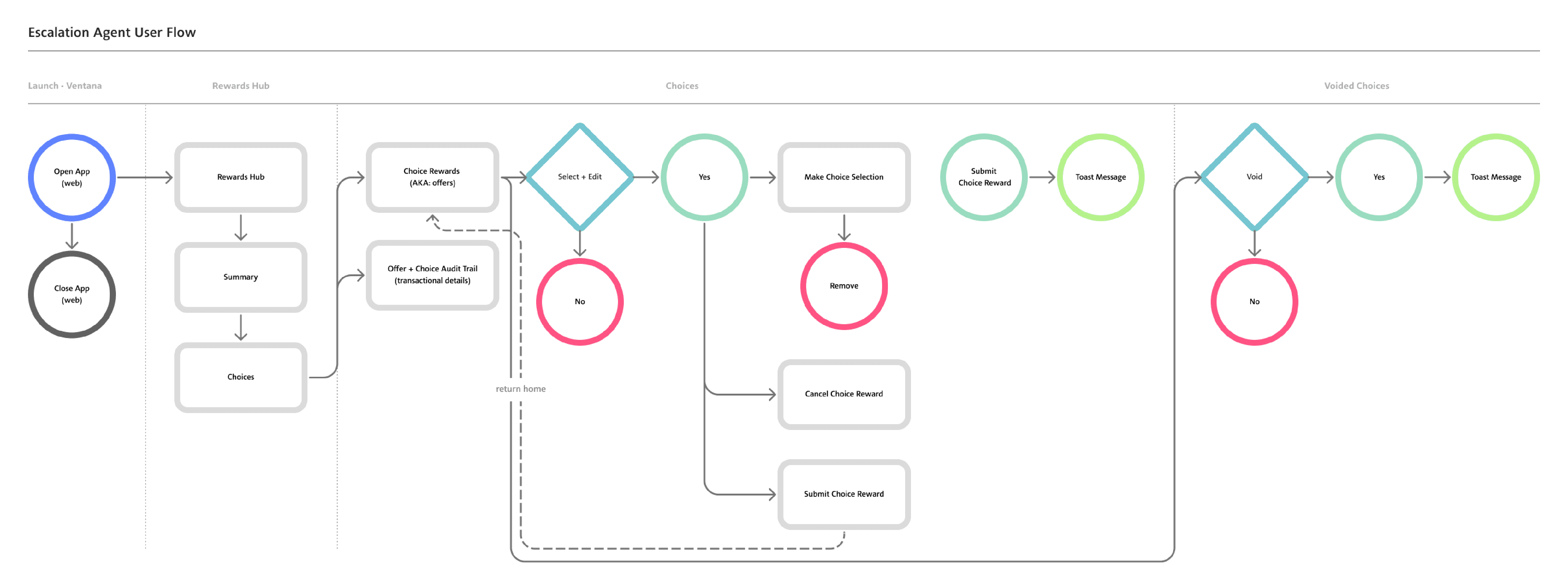

Both workflows share a common transaction structure, with role-based permissions determining which actions are available.
03
THE PROCESS
Research first, architecture second.
Before defining the interface, I needed to understand how different roles used the platform, where their workflows broke down, and which system behaviors created the most friction.
I combined qualitative research and workflow analysis to identify recurring needs, organize usability issues into shared themes, and prioritize the transaction states that required the most attention. These findings provided the foundation for the information architecture and interaction patterns that followed.
B. Empathy mapping – Four Roles, Shared Challenges.
I synthesized fourteen agent interviews into four empathy maps representing Agents, Escalation Agents, Admins, and Guest Viewers. The maps captured what users observed, said, heard, thought, and felt while interacting with the platform.
Comparing these perspectives helped distinguish role-specific challenges from recurring usability issues across the experience.


Mapping what users see, say, hear, think, and feel.
// The four maps revealed distinct pain points across user roles. Affinity clustering brought those findings together, helping identify common patterns that could inform the broader design.
C. Affinity Clustering – Identifying Shared Patterns.
I grouped interview observations, reported pain points, and workarounds into related themes. Three recurring questions emerged: Can users find the information they need? Can they anticipate what will happen next? Can they recover when something goes wrong?
These themes helped translate qualitative findings into concrete design priorities: clearer visibility, more predictable interactions, and better support for error prevention and recovery.


Three recurring needs shaped the design: visibility, predictability, and recovery.
D. Emotion Mapping – Prioritizing High-Friction States.
I mapped emotional intensity across five key transaction states to understand where users experienced the greatest frustration. Voiding and depositing emerged as the highest-friction stages, making them priorities for the initial interface design.
The findings helped focus design effort on moments where clear status information, predictable actions, and appropriate confirmation were especially important.

Friction Peaks at Voiding and Depositing
// Emotion mapping highlighted voiding and depositing as priority states for redesign.
04
THE SOLUTION
A Clearer, More Predictable Transaction Experience.
The redesigned interface makes transaction status and available actions easier to understand throughout the workflow. I replaced unnecessary modal interactions with contextual inline edits, positioned confirmation steps closer to the actions they supported, and brought status indicators into more visible locations.
These changes reduced the need to navigate away from the current task to understand what was happening or determine the next step. The goal was to make routine transactions easier to complete while reducing reliance on external training materials.
67–83%
reduction in agent handling time measured
post-launch across choice rewards transactions
HANDMADE / DIGITAL
THE BEFORE
05
REFLECTION
+ RESULTS
A Product Improvement with Broader Influence.
The redesign delivered measurable improvements to Choice Rewards transactions, including a 67–83% reduction in agent handling time. It also reduced reliance on training materials and internal escalations while improving the predictability of the interface.
Beyond the immediate product, the project helped establish a case for applying similar design improvements across the broader Ventana Rewards Hub. Its influence extended to related customer-facing choice-selection flows, demonstrating how improvements to internal tools can benefit the wider service experience.
01 · OPERATIONAL
Faster calls, lighter training
67–83% faster agent handling. Dramatically reduced reliance on training materials. Fewer internal escalations across the loyalty team.
02 · PEOPLE
Agent confidence restored
New agents are productive without the binder. Veteran agents gained predictability. The tool stopped being the thing standing between them and their customers.
03 · SYSTEMS
A ripple, not a redesign
Catalyzed a complete Ventana Rewards Hub rebuild and influenced customer-facing flows. The agent tool was the beachhead — the ecosystem was the real territory it opened.
This project reinforced the strategic value of internal product design. Improving the tools employees use to serve customers can reduce operational friction while creating a foundation for better experiences across the wider product ecosystem.